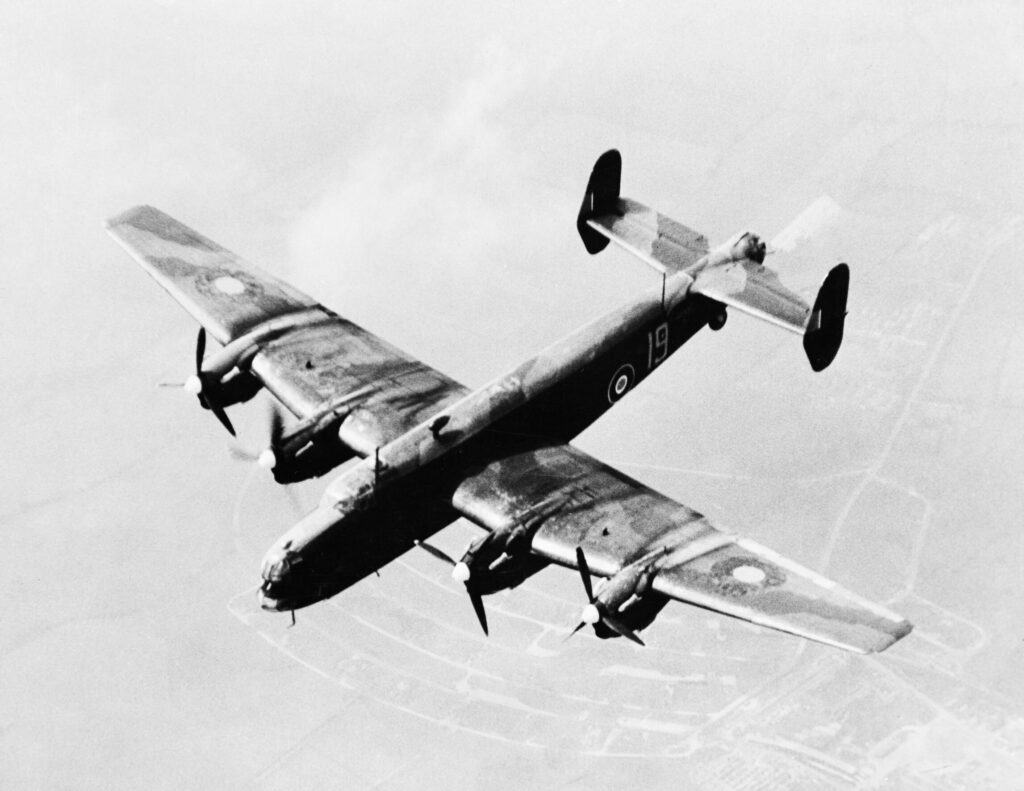
Robert J. Thomas’s meticulously researched novel The Halibag Boys: A Time To Fly is a gripping account of an RAF crew in northern England aboard the heavy bomber Handley Page Halifax, known as the Halibag, during World War II. The author answers our questions about the novel and how he wrote it. How do you feel about being a published fiction author? Do you consider yourself an historical novelist? Obviously, it’s a pleasure to be published, it’s why we write books to reach a wide audience. A lot of work goes into a novel and to see it in print and on the shelf for sale is an achievement, people spending their money to buy it and hopefully enjoying it an honour. Although historical fiction is my preferred format for novels, I also write general fiction, as well as nonfiction titles. I create what inspires me, I have several projects on the go at any time, which one is worked on today depends on my mood. I find it helps not to be tied to one genre, after finishing a novel I find non-fiction cleansing. The story is told through the eyes of newly qualified flight engineer John Jenkins. How did he and the times you write about in this novel first lodge in your imagination? John, the central character of The Halibag Boys, was a real person, though his name has been changed. He was a direct relative of mine, though I never met him. After the passing of my mother in 2008 I began researching my family tree, not an uncommon activity after losing a parent I’ve since found out. During this research I stumbled across John, though initially just evidence that he once existed. I was aware of him vaguely as I had been told as a child he had served with Bomber Command during World War Two, but all those who could tell me more in later years were gone. Purely by chance, as is often the case, a photograph of John came into my possession. He was standing with a group of men beside an aircraft, this set me down a road that led to opening up his life to me. From this photograph I identified the aircraft, it was a Handley Page Halifax. At this time, like many people, the British bomber of the war was the Lancaster as far as I knew. Having established the Halifax’s identity I was able to determine that John was not in Bomber Command, but was in fact part of the Middle East Command and attached to the Royal Australian Air Force, though a member of the RAF. Armed with this knowledge I set about finding his story, at this time with no intention of using it for a novel. Facebook of all places led me to that eureka moment all researchers dream of, I found the son of John’s pilot. A friendship began that has led to over ten years research into not only John, but the aircraft he and the crew used. As part of this research RAF Riccall came to my attention. At first it was nothing more than an entry on John’s service record. Realising where it was and that I had once lived not thirty minutes from it without knowing of its existence, I began to research RAF Riccall as well. More years of work followed, including many visits to what remains of the station today. It had been my intention to write a history of RAF Riccall as a non-fiction book, I had already completed one on John’s Halifax, the one in the photograph. I wrote instead John’s biography, a humongous book covering everything I knew of his life, which by then was quite substantial. John’s story I thought was complete. As with many things that change your life, one day a lightbulb went off in my head fictionalise John’s story. I thought it was an excellent way to tell it, and make something a wider audience would want to read, non-fiction being rather limited to those only interested in its subject, I believe. Where to start I pondered, his beginning wasn’t anything special, but his war record was. As a big kid at heart, I love all things World War Two and over the years become quite an authority on the Halifax and the squadrons John served with. I like Riccall village and made friends there, I knew the former station well and had become quite an authority on it, it all fell into place. Everything I needed I already had, volumes of books, hundreds of documents, maps, all the research I needed to write an historical novel based at RAF Riccall was in my office and my head. Laying in bed one night, unable to sleep, the opening paragraph entered my head and The Halibag Boys: Time to Fly was born. What place does research have in your writing? When does the fiction take over from the facts? Research is of paramount importance. If I can’t find what I need for a book and prove it, I will leave it out rather than make something up. I like my locations to be real, either still or have existed. I tend to change the names of town, streets, buildings etc but always base them on maps or images I have. In Halibag Boys when the lads are walking through RAF Riccall each step is planned against the real RAF station and plotted on the station map I have. Buildings are where they should be and for the purpose they were used in reality. I want the reader to walk through the station with them, as I did when I wrote it. Fiction, for me, takes over for the interaction between people, and sometimes to abridge events that actually took place to suit the story. As an example, in the book my heroes nearly get hit by a piece of debris flying of a broken propeller on a taxiing Halifax. This
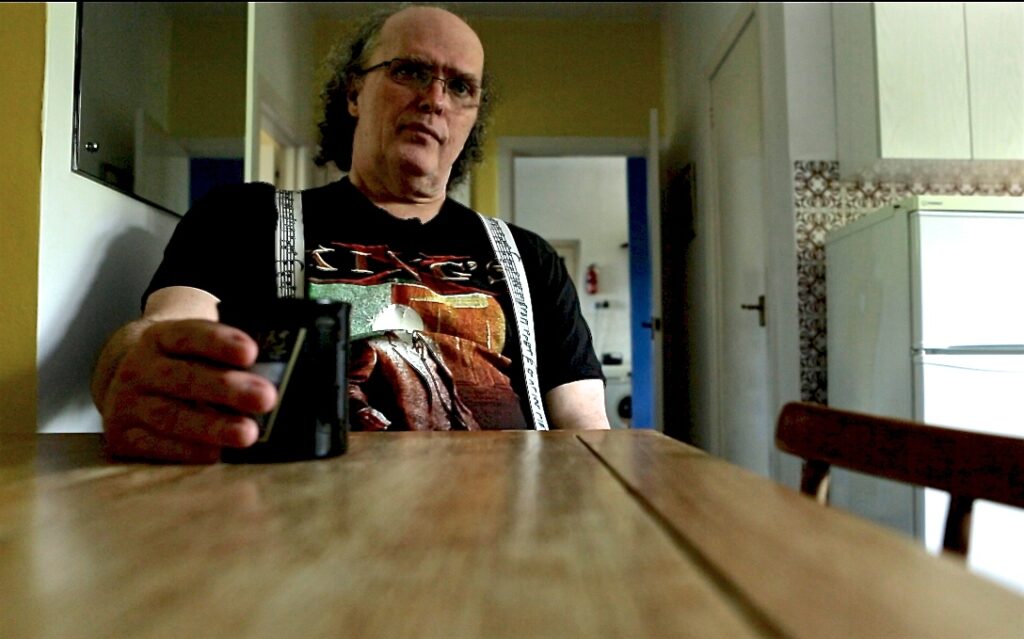
N.C. Fortune lives in the Cotswolds. He is a poet and former musician, playing the drums in bands. His first novel Falling Story is a supernatural coming of age ghost story about a girl who went missing in a Gloucestershire village in the 1980s. James Baxter, author of Samuel Beckett’s Legacies in American Fiction, wrote that Falling Story is “an artfully constructed and emotional ghost story and folk horror” with the potential to achieve enthusiasm among horror fans, as well as “high-concept horror cinema” appeal – The Blair Witch Project meets Paul Auster. What attracts you to the genre of horror? My Grandfather and uncle used to tell me ghost stories as a young boy and this in turn attracted me to the horror genre. I get the impression that you’ve been writing most of your life, what were your early influences? I’ve been writing in some form since my early teens and a main early influence on me was the writings of J.R.R. Tolkien.Was it always going to be horror? No. I tried to incorporate aspects of mystery and the supernatural into my novel as well as horror. I was keen to avoid horror cliches which could have greatly detracted from the impact of the story. The novel’s central location of Prestbury, Gloucestershire provides a vivid backdrop to the story (there are historical claims of the area being amongst the most haunted in England). Have you any real life experience of ghosts? Yes several. One such incident was when one night whilst stargazing, i saw a luminous patch of light form in the field next to my garden and slowly drift across it before then dissipating. I live close to Prestbury have extensively researched the ghost stories attached to the village and the surrounding area. What is your writing process? After an initial concept for a poem or story, I try to collate ideas from various sources then try and pull them together to form a cohesive piece. The first thing that strikes me about your writing is that it’s very filmic. How did you arrive at this point, and are there influences from movies feeding into that? The filmic aspects of my story developed over time and were as a result of different plot strands coming together. Film wise though I loved the Hammer horror films of the 1970’s and other classic horror films such as The Exorcist and The Fog and I’m sure these helped shape my story in some aspects. How do you manage to navigate what has already been done before in the genre? You are working in a field where so many of these images have been so well-trodden. I try to be true to the story and avoid sticking to one genre. I find this lends itself to originality and lessens the chances of falling into the traps of horror cliche. Who have you been reading lately? I have recently been reading a biography of the Welsh poet Dylan Thomas. Name a book that made you want to write. The Lord of the Rings by J.R.R. Tolkien. Falling Story by N.C. Fortune is published in the Autumn by Foreshore. N.C. Fortune was born in Streetly, Staffordshire, with the congenital condition Spina Bifida. He moved to the Cheltenham area in 1978 and on his twelfth birthday was given a drum kit, which led to him becoming obsessed with drumming and music. He spent his teens through to his early forties playing the drums in bands, often professionally, only stopping when his disability worsened. His grandfather first told him stories of the paranormal which both scared and intrigued him, and in the 1980s he had a ghostly experience which further developed his fascination. Around this time, he visited Prinknash Abbey near Cheltenham and in the café bookshop found a copy of a book called Mister God, This Is Anna by Fynn which served as one of the inspirations behind Falling Story. N.C. Fortune is a poet and lives on his own in the Cotswolds. ORDER YOUR COPY James Baxter, author of Samuel Beckett’s Legacies in American Fiction, wrote that Falling Story is “an artfully constructed and emotional ghost story and folk horror” with the potential to achieve enthusiasm among horror fans, as well as “high-concept horror cinema” appeal – The Blair Witch Project meets Paul Auster. Smart but troubled, Jo has a secret – she can see ghosts; and after opening the family grimoire, she finds herself at the centre of an intoxicating occult ritual. Falling Story is a supernatural coming of age ghost story about a girl who went missing in a Gloucestershire village in the 1980s: M.R. James for a new generation. Add to Cart
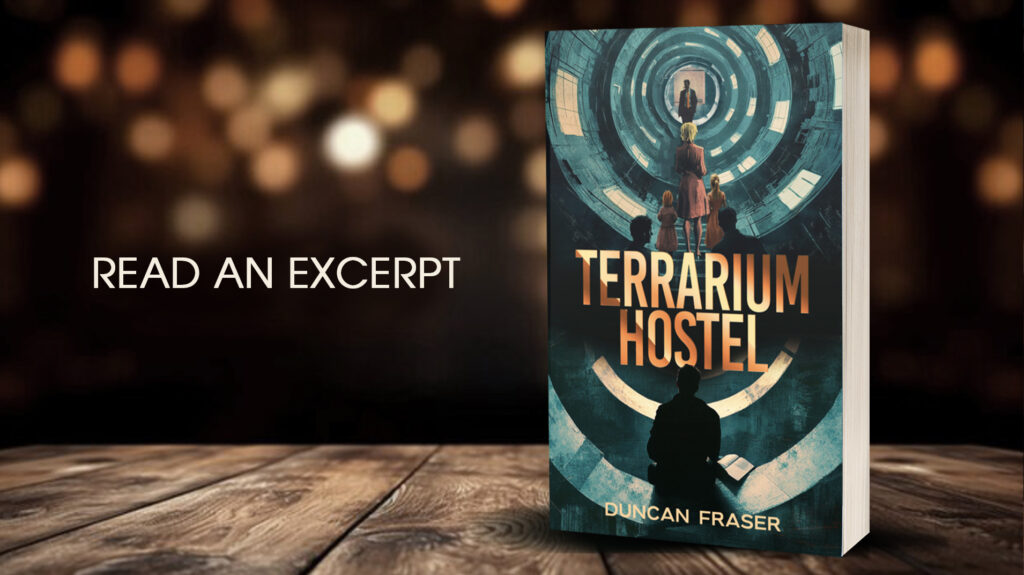
A story of ordinary lives against a backdrop of cosmic stakes, Duncan Fraser’s captivating and unique speculative fiction debut Terrarium Hostel explores themes of connection, belonging, and self-discovery. Day 1 – Keeping a Diary It was Octave one night in The Moscow Arms who told me about an article he saw in the paper about writing to aliens. I laughed at first but when he explained that this thing called the Sol Project was a deadly serious scientific enterprise in which ordinary people had been invited to participate, I became intrigued and sent off for an entry form. The Pinkland Space Agency is going to beam powerful radio signals towards a star about 35 light years away in an attempt to make contact with an alien civilisation they think is there. The signals will contain many different kinds of communications. There will be greetings and messages of peace from our insincere politicians and summaries of our knowledge from boffins in various fields. But also included will be diaries from average Joes like myself in order to give the aliens as wide an appreciation as possible of life in this neck of the galaxy. I received the entry form a couple of weeks ago and ever since then Octave has kept asking me if I have started the diary. So I bought a large notebook and today I begin writing in my diary for the first time. I have asked him why he wasn’t also going to do it, since he is so enthusiastic about me doing it. ‘My diary would never be accepted,’ he said. ‘Why not?’ I said. ‘The judges will all be Darlingtons,’ said Octave. ‘What’s that?’ I said. ‘Darlingtons?’ said Octave. ‘Culture vultures. Precious, self-important, loose-living bohemians. You know, arty-farties. Those kind of people wouldn’t consider a diary from someone like me for one second, no matter how good it was.’ ‘How do you know that?’ ‘Just take it from me,’ said Octave, ‘I just know. The kind of people who judge literary competitions are always Darlingtons.’ I had never heard of the term. Must be a Terrarium word. ‘And they are all absolutely stupid,’ Octave added. ‘Total dum-dums. They wouldn’t understand anything I wrote.’ ‘So why do you think my diary will be accepted but yours will be rejected?’ ‘Because you are a fresh-faced, innocent idealist,’ said Octave. ‘They like people like you.’ There is a great expectation that the messages will be understood because apparently the radio signals will also contain sophisticated translation instructions which will, if you have information systems that are compatible, enable you, my dear alien reader, to read the messages in your own idiomatic language and render my unearthly existence in terms that will appear bizarrely familiar to that of your own species. For example, whenever I mention my home star, I will write it as the name I know it as but it will appear in your text as Zeta Herculis B, which is your name for it. Obviously, I don’t call it that and have no idea what you call it. But that is how it will appear in the translation. Sometimes what you read will be a surprisingly accurate description of my reality. At other times though it will be an approximation or a symbolic interpretation of what my life is actually like. But I think the idea is to always make it consistent with a correlate in your world while remaining true to the spirit of my world. I will probably sound more articulate than I actually am but the software will always try and render an accurate representation of what I am saying and strike an emotionally faithful tone. The best analogues will always be used. For example, there is an intelligent aquatic creature in the oceans of our home planet that we call a …well, frankly, a vocalisation that is unlikely to be reproducible in your language … but which will be translated as a dolphin because that is the closest counterpart in your world. (If that last sentence appears even vaguely intelligible to you, I will be amazed because I don’t know if you have any intelligent aquatic creatures in your oceans. Do you even have oceans?) I also might mention at some point that I play a musical instrument. I don’t know how this will be rendered. Do you guys even have music? Even if you do, what are the chances of you having anything like the thing I play? Pretty remote, I would say. But the instrument I play will be described in terms that you can understand – so I play a guitar. Neither of us will know how good a translation that will be. But who knows? Your instruments and our instruments may be remarkably similar. My civilisation has made great advances recently in communications and many people are calling this translation technology the greatest thing we have ever achieved. If you are reading and understanding this, my dear alien reader, then I guess they might be right. I am sure it will at least be better than the old indecipherable hieroglyphics and mind-bending mathematical brainteasers that you poor aliens used to get from us. There is still a possibility though of some very bad errors. The artificial intelligence of the translation technology may find a suitable analogue in your world but not believe it and retranslate it into something preposterous to your ears. Apparently this has happened very occasionally in tests. So if you read the odd weird or unintentionally funny thing, put it down to the stupidity of artificial intelligence. But it’s not my job to explain the technical side. I don’t understand it anyway. My job is to describe my life. All the relevant explanations will be in the Space Agency’s ‘covering letter’, as it were. What they told me in the guidelines is to write as if the reader is completely familiar with my world. I am not to attempt explanations. Personally, I don’t