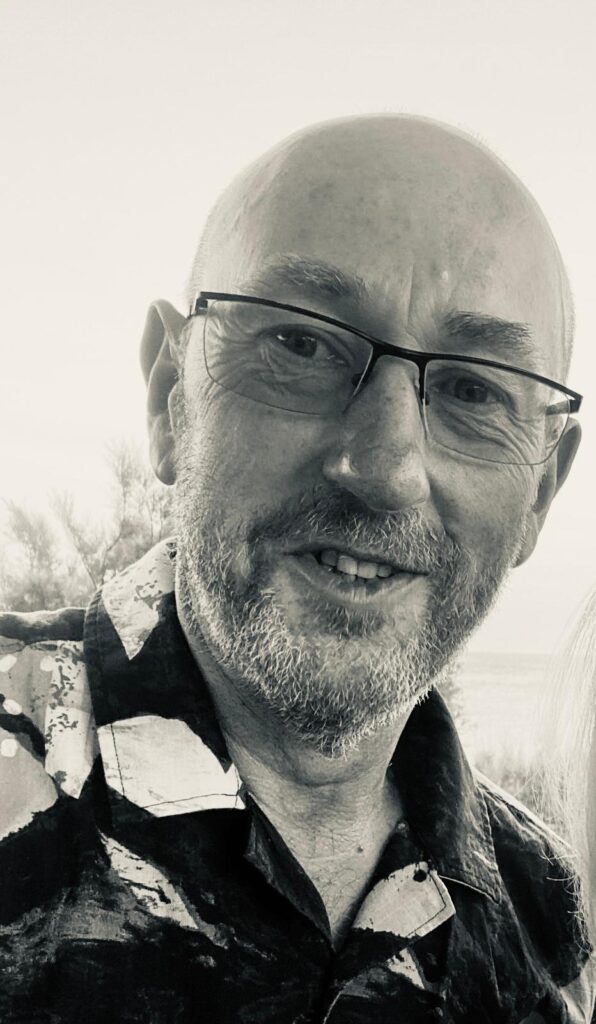
“Kiwi took over — I simply followed.” Roger Emms’ controversial, fearless and unsettling novel About Your Daughter. Interview by Phil M. Shirley It was a mild, perfectly typical autumn afternoon when I met Roger Emms in the crowded Waterstones café on Gower Street, a short walk from his London home. The pavements were damp from a brief, forgettable shower; students drifted in and out with tote bags and half-formed essays; and the low hum of people sheltering among books created its own warmth. Briefly back from Grenada, Roger settled easily into a corner table—composed, observant, with the quiet intelligence of someone who has spent a lifetime watching people. He speaks the way he writes: measured, unhurried, uninterested in superficialities. His debut novel, About Your Daughter, is as fearless and unsettling as the mind behind it. For thirty years, Roger has lived in the Caribbean, a place that quietly permeates his work. Before turning to fiction, he led a substantial professional life: founding a London-based healthcare research and consultancy organisation working across Africa, Southeast Asia, the Caribbean, and the Middle East on reproductive health, HIV/AIDS policy, and other conversations governments often struggle to have. He has also worked in a children’s psychiatric hospital and supported a home for abused children. It is the kind of CV that could sound pious or self-important in the wrong hands. Roger does not perform gravitas; he states facts, then moves on. About Your Daughter did not begin as a novel intending to provoke. It began, he tells me, with a tree. “I started with the silk cotton tree I know well,” he says. “A real tree, overlooking the harbour where the slave yards were. I imagined a girl—Kiwi—talking to it, consulting its age and wisdom. That was the story.” He pauses, amused. “Then Kiwi took over. And I let her.” What followed is a daring work of literary fiction that inhabits the inner life of a pre-teen girl on a Caribbean island—her imagination, private desires, confusions, fantasies, vulnerabilities, and power. The silk cotton tree becomes her confidante, a gateway to a more complicated understanding of herself. Roger enters territory most writers avoid altogether, or approach only from a safe adult distance. He refuses both. Kiwi’s story, he explains, grew from three preoccupations rooted in his long-standing interest in child psychology and the blind spots of adulthood. “There’s this idea,” he says, “that parents understand their young daughters—or even want to. But they often know very little about what’s actually happening in their children’s emotional or imaginative lives. Sexual development frightens people. They close the door on it and pretend the child has closed the door too.” In About Your Daughter, Kiwi’s world becomes a site of collision: innocence and agency, fantasy and danger, curiosity and transgression. Roger avoids didacticism, offering no warnings, lessons, or endorsements. Instead, he attempts something bolder and harder—an act of attention. He tries to understand a young girl’s consciousness from the inside. “In literature,” he says, “young girls are often narrated by adults who want something from them. Or they’re moralised into symbols. What interested me was: what if Kiwi told her own story? What if we listened to her voice without cleaning it up?” Nabokov inevitably comes up—not as a model to imitate, but as a literary problem to answer. “Dolores Haze didn’t get to tell her own story,” Roger says. “We only heard Humbert Humbert’s version. I wanted to imagine the girl who does get to speak, unfiltered. What would she insist on? What would she hide? What would she misunderstand? What would she exploit?” Kiwi is portrayed not through an adult gaze of scandal or titillation, but through the shifting perceptions of a child trying to map unfamiliar impulses onto a world that offers her almost no guidance. She is naïve and knowing, vulnerable and manipulative, tender and—at times—cruel: contradictory in the way real children are, though adults rarely admit it. “She fascinates me,” Roger says, “not because she’s a symbol, but because she’s a child trying to make sense of adult behaviour she doesn’t yet have the tools to interpret.” The novel also confronts the blindness of adults—their desire not to know. Kiwi’s parents, and the parents of her friends, move through the book with a touching and dangerous obliviousness. “Intergenerational silence,” Roger calls it. “We pretend not to see what we fear. But that doesn’t mean the child isn’t thinking—or acting.” This uneasy mixture of misunderstanding and power is one of the novel’s most unsettling elements. Roger describes it calmly, without melodrama. “The stereotype is the older man exploiting the young girl,” he says. “But that isn’t the whole story. Children can be exploitative too—not because they’re wicked, but because they’re inexperienced, impulsive, emotionally uneven, and sometimes more powerful than they realise.” About Your Daughter does not ask the reader to approve of anything. It asks only that they stay in the room—to resist flinching away from the discomfort of childhood interiority. Was it difficult to write? “I didn’t think it would be publishable,” he says with a small shrug. “I was writing it for myself. And for Kiwi.” Most major UK literary agencies turned it down, which he took as a promising sign. “Algorithms,” he says, with a grim smile. “They like the predictable. Kiwi’s mother says the industry is full of sharks and cannibals. She was probably right—though she didn’t know about the robots.” Foreshore Publishing, he adds, was the first publisher to read the manuscript as literature rather than a problem. “I wanted an independent publisher who wasn’t terrified of a difficult book,” he says, “who understood what it was actually doing.” He looks around the packed café and smiles. “People underestimate readers. They underestimate what fiction can hold. Kiwi’s story isn’t written to shock—it’s written to make you think differently about what children know, and what they hide.” When our conversation ends, the café has grown louder, the light outside beginning to fade. Roger buttons his coat, thanks me politely, and
From the director known for work on The Avengers (1998), Solo: A Star Wars Story (2018), and The Batman (2022). Foreshore Books Announces The Green Man, a New Supernatural Horror Thriller by Mark Woollard — Coming Autumn 2026. Foreshore Books, the small-press imprint of Foreshore Publishing, is excited to announce the upcoming release of The Green Man, a chilling new supernatural thriller that draws on one of Britain’s oldest and most intriguing myths. Set in the deep forests of southern England, The Green Man follows John Turner, an ex-soldier seeking quiet work and recovery far from his past. But when a series of disturbing incidents begins near an ancient Iron Age site, Turner finds himself pulled into a mystery that unsettles both locals and investigators. As old symbols, forgotten histories, and buried emotions resurface, Turner discovers that the forest holds far more than legends — and that the past, both personal and ancient, is not as distant as it seems. The story unfolds with creeping dread, blending psychological tension with mythological mystery as Turner is drawn into events he cannot ignore. Joined by journalist Lowry Warner and historical theologian Peter Howell, he must confront forces that defy explanation and a darkness that seems to wake with every step deeper into the woods. Phil M. Shirley, Publisher at Foreshore Books, said: “The Green Man is a gripping, atmospheric thriller — a modern story woven through with ancient echoes. Mark Woollard brings a cinematic depth to the page that horror and mystery readers will love.” About the Author Mark Woollard is a British writer and director with a forty-year career in film and television. He has contributed to many major franchises, including Harry Potter, Star Wars, Tim Burton and Christopher Nolan’s Batman films, as well as the Marvel universe — and even a James Bond film. Woollard was mentored by the late legendary producer Gerry Anderson (Thunderbirds, Space: 1999), with whom he developed television projects and co-wrote Anderson’s final feature-film script. He is currently directing an animated feature scheduled for release in 2027. The Green Man will be published by Foreshore Books in Autumn 2026.

As Springtime in the Bones prepares for its English debut, it offers readers a rare and resonant journey—a tale of trauma and tenacity, heartbreak and humour, told with an uncompromising poetic voice. It is a testament to the healing power of storytelling and the indispensable value of bringing diverse voices into the global literary conversation. At the heart of Springtime in the Bones is Luísa—a successful publicist navigating the aftermath of two earthshaking events: a violent rape and a painful divorce. Állex Leilla’s narrative courageously explores this woman’s deeply personal journey of anger, heartbreak, and ultimately, renewal. Speaking about her novel, Leilla describes it as “a novel at once poetic and painful, because it shows a woman rebuilding after suffering a rape, and, shortly before this assault, going through an equally difficult divorce. Luísa has a very peculiar sense of humour, loves literature, rock, and film. The story revolves around her quest for revenge and rediscovery—the metaphor of spring renewing everything that winter froze perfectly fits her transformation.” Though the novel was first published as Primavera nos ossos in Brazil in 2010, its themes remain urgently relevant. Leilla reflects with both hope and sorrow: “It’s been 15 years, but the rates of sexual violence in Brazil remain high, especially in the big cities. Rape is one of the most abject forms of violence anyone can suffer. I hope the translation brings renewed attention to this important issue as well as the novel’s other layers.” For Leilla, the English translation is also a portal back to a pivotal time in her life and writing. “Surprisingly, I feel very connected to Primavera nos ossos today because I’m preparing my diaries from the period when I wrote it. These diaries bring old memories and insights to light, allowing me to revisit the emotions and context that shaped the novel’s creation.” Readers can expect more than a raw story: “They will encounter an authentic and complex adventure. I wanted to combine action—sometimes violent—with moments of poetry and humour, keeping paragraphs short and dialogue dynamic to make the story flow energetically.” Amanda Sarasien’s path to translating Springtime in the Bones began in 2020 when Leilla’s Brazilian publisher Casarão do Verbo sent her the manuscript. “I’m always drawn to literature from Bahia, a region rich in culture but underrepresented in translation. The book’s premise—a rape survivor plotting revenge in a noirish tale of impossible love—immediately drew me in. But it was Leilla’s voice, the musicality of the prose, and her playful, subversive manipulation of language that truly captivated me. This is an author who reveres language, both its power and limitations.” The translation process was a marathon of dedication and creativity. Sarasien explains: “It took about four years, juggling this with other projects. I usually read a book once before starting to translate, but with this novel’s cyclical, fragmented narrative and recurring themes, I re-read it many times. The narrative isn’t chronological—it loops like the seasons—so I often had to jump around in the manuscript to maintain consistency and grasp the full arc.” She adopted a strategic approach: “I translated the dialogue first to give the characters their voices in English. Dialogue is tricky to render authentically, so it was important to get that right from the start. Then, I tackled each chapter with multiple drafts, refining and revising. Sometimes, I spent an entire day on one paragraph to capture all the layers, images, and double meanings.” Extensive research and frequent discussions with Leilla helped Sarasien navigate the literary and pop-culture references peppered through the text. “Our collaboration was rewarding. Állex was always available, generously answering my questions without looking over my shoulder, and our correspondence became a rich exchange of insights—not only about the book but about literature and life.” For both Leilla and Sarasien, translated literature is a bridge connecting people beyond borders. Leilla highlights the broader cultural significance: “Literary translation is crucial for cultural exchange. It dissolves geographic boundaries of time and space, bringing people closer. We gain an intimate understanding of diverse cultures—both their unique features and universal human truths.” Sarasien points out the riches to be discovered in translated literature: “Anglophone publishing continues to produce only about 3% work in translation. In contrast, readers in many other languages engage extensively with fiction from around the world, so their literatures are in constant dialogue with ours. Translation into English makes that literary conversation a little less one-sided, infusing new voices, perspectives and narrative experiments into the canon. It’s thrilling and essential.” Beyond this project, both have rich literary backgrounds that shape their work. Leilla’s inspirations include classics like The Magic Mountain by Thomas Mann, which she admires for encapsulating twentieth-century history, The 25th Hour by Constantin Virgil Gheorghiu for its deep psychological insight, and Brazilian author Caio Fernando Abreu who showed her how to write poetically in prose. Sarasien’s literary path started early with a passion for languages—Spanish, French, Portuguese, and Mandarin—and a love of reading and writing. A late-career shift brought her into literary translation after an acquired disability. Her translating career took over a decade to fruition, marked by persistence and community support. She recommends aspiring translators to: “Read widely in all their languages, stay current with publishing trends, understand the markets in both source and target languages, and find a supportive community. Translation is a long road but deeply rewarding.” Her personal literary inspirations include Don Quixote studied in original 17th-century Spanish, which taught her about novelistic form; Jane Eyre for its layered themes and gothic atmosphere; and Ali Smith’s How to Be Both, admired for its linguistic playfulness and innovation. Foreshore Books, the small press imprint of Foreshore Publishing, will publish Springtime in the Bones in March 2026. AMANDA SARASIEN is a writer and literary translator working from Portuguese and French. A recipient of a 2022 National Endowment for the Arts Translation Fellowship, her work has appeared in Electric Literature, The Common, Chicago Review of Books, and elsewhere. She is a founding member of the Third Coast